
January 22, 2022
The Four Seasons - the full EP series is here!
Today (22-01-2022) I have completed the cycle with the 4th EP of the series. You can listen to the entire concept album here:


January 8, 2020
August 5, 2016
Hi, I'm very happy to present you the first part of the EP series I've
been working on. It's been a long ride:
I've changed my music attitude, I felt I'd like to compose more meaningful music, which
is not about a particular instrument.
The result: The Four Seasons - Part 1: Spring.
Bandcamp link of the EP: https://jonastamas.bandcamp.com
The result: The Four Seasons - Part 1: Spring.
Bandcamp link of the EP: https://jonastamas.bandcamp.com
July 9, 2015
Instant Guitar Licks 02►Multi String Tapping (with TAB and backing track)
I have uploaded the second episode of the Instant Guitar Licks
series.
There is a real-time TAB as well as a "karaoke" section in the video.
I hope you find this tapping idea useful!
There is a real-time TAB as well as a "karaoke" section in the video.
I hope you find this tapping idea useful!
June 3, 2015
Instant Guitar Licks 01►Slide & Tapping On The Same Note (with TAB and backing track)
I'm very happy to present the FIRST video of my guitar instructional video series. Expect a lot more to come, so it's worth subscribing to my channel.
_
Happy practicing, and share this video if you think your guitarist friends will find it useful!
_
YouTube video:
_
Happy practicing, and share this video if you think your guitarist friends will find it useful!
_
YouTube video:
January 8, 2014
Lesson and interview with Gianluca Ferro
Hi! The last couple months were amazing - I've organized the latest edition of my annual Jonas Tamas Guitar Contest in Hungary. This year, judges included Steve Lukather and Guitar World Editor-in-Chief Brad Tolinski, plus some of Hungary's finest players and other internationally acclaimed guitarists, including Gianluca Ferro from Italy, Rick Graham from the U.K. and Mathias Holm from Sweden.
Guitar World has written an article about the contest, featuring the 3 most exciting guitar video entries. You can check it out here: http://www.guitarworld.com/videos-three-outstanding-entries-annual-hungarian-guitar-competition
Gianluca Ferro has been one of the judge panel members, and he has written and recorded an amazing solo over the contest backing track. Here is his video:
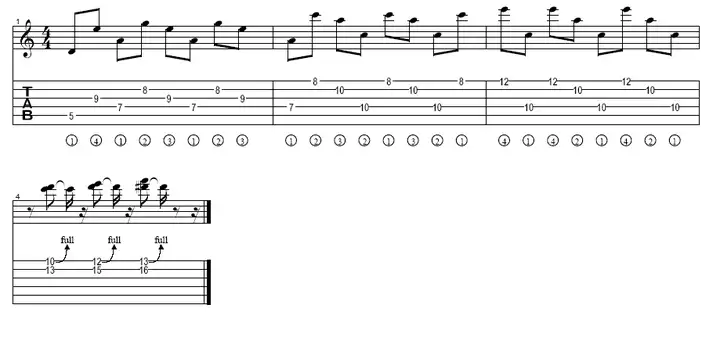
This is the TAB of the chorus (0:48), with great intervallic lines and well-rounded 3-note stucture:
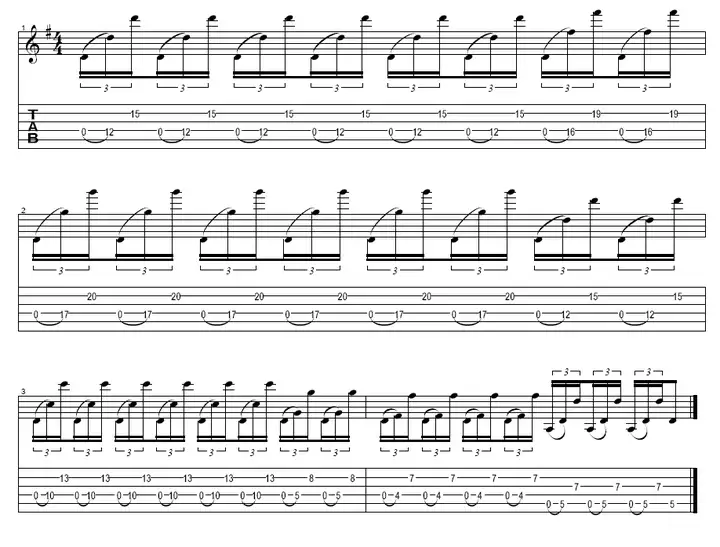
This is the hybrid picked part at 0:37:
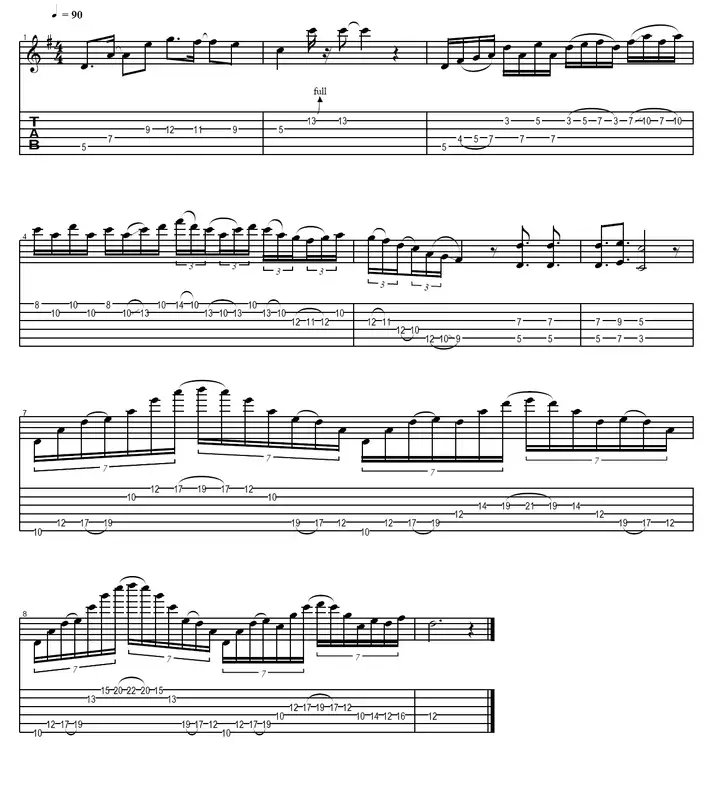
And finally, this is the first 8 bars of Gianluca's solo. In the last two bars there are multi-finger tapping sequences in septuplets. You can use your 1st and 3rd finger, or your 2nd and 3rd finger, respectively. Make sure to practice it slowly, and take care that all the notes sound clean and even. You can also use a hairband on the neck of the guitar.
This week I did an interview with Gianluca for my Hungarian guitar column at GitarShop.hu. With the permission of GitarShop, here is the English version of the interview:
Hey Gian, thanks a lot for taking part in this interview! You’ve got a great year in 2013, with new Jam Track Central packages, ESP endorsement, new videos and exciting gigs. What are your music plans for 2014? (New solo album, side projects, guest solos, clinics, etc.)
Hi Jonas! It’s such a great pleasure to be here with you guys!
Yeah 2013 has been a really intense year I had the chance to perform with Guthrie Govan, Andy Timmons, Kiko Loureiro, Michael Angelo Batio and the amazing Prashant Aswani. I also have been working a lot for Jamtrack Central, as you said!
2014 starts with a blast, anyway... I’m gonna perform at NAMM in California for Dragoon Speakers, an italian company.
As for the new projects, I’m working with Nick Pierce, drummer of Unheart at a new band called Breath Of Nibiru, we are now mixing our debut album with Aaron Smith (Jeff Loomis, Into The Flood, 7 Horns 7 Eyes). In the meanwhile I’m working on a new jamtrack package. I’m also scheduling some clinics in Europe for next Spring!
Nowadays, what is your practice routine? How do you maintain and develop your technique, your chops, your fluid runs?
Well, I spend the most of my time writing songs and putting new ideas together! I teach a lot so I only have my mornings and weekends free.Anyway I try to save as much time as I can refining my chops and inventing new lines. Right now I’m more focused on phrasing, trying to combine more chromatic fragments and arpeggios with a hint of hybrid picking as well as some 4 note-per-string fingerings.
It’s not a super-organized routine as it was in the past; Yep, I still practice with my metronome, but I’m not that obsessed by technique nowadays. It’s more about finding new ideas then getting hyper-fast!
Luckily summer is free so I usually play almost the whole day !
What is your typical creative process when you write new material? Do you come up with riffs first, do you start a drum track and play melodies over it, or is it a different method?
Well it might change a lot! Sometimes I listen to a song at the radio and I think:” that sounds pretty cool!” so I try to get the same vibe for my stuff trying to figure out how the chords are moving around and how the whole arrangent is built. That works fine for the more melodic material. Sometimes it’s just noodling around a drums groove or sometimes it’s an actual project in my mind with different sections and elements. I always try to be balanced and organic with my songrwriting. I need to feel every element compensating the others. So, if I have a very melodic chorus I might be searching for a more harmonically complex verse etc... When I need to get freak I often experiment with synthetic scales,symmetrical chord progressions or weird harmonic process. I take a piece of paper and start drawing weird diagrams! It’s a good way to bring your thoughts outside your box but,of course our ears have to judge the result!!!
How you motivate yourself and please tell some main factors that contributed to your success as a musician! I’m especially curious to know your inner self-talk and positive beliefs that help you to go forward and be persistent.
I think that every step you take brings yourself a little bit higher. Doesn’t matter if you just came down from a stage where you performed in front of 25.000 people or you just learned a new position for a scale in your bedroom.
You just have to know that you’re going somewhere and that’s a cool place to go. I think you’re truly alive as long as you try to do your best every single, day. As a musician and as a human.
You might make mistakes; all right. Then you’ll learn from them. You might be tired and lost sometimes but you still will have your path to follow; sooner or later your efforts will be rewarded in some way. Just enjoy your stroll, enjoy the view, be alive, humble and positive and don’t care very much about the destination!
Thanks for your time and in the name of the GitarShop.hu staff I wish you lots of success and fun for 2014!
Thank you so much guys for taking me on board! Hope to cacth you all soon ! All the best for 2014 to all the GitarShop friends !
Guitar World has written an article about the contest, featuring the 3 most exciting guitar video entries. You can check it out here: http://www.guitarworld.com/videos-three-outstanding-entries-annual-hungarian-guitar-competition
Gianluca Ferro has been one of the judge panel members, and he has written and recorded an amazing solo over the contest backing track. Here is his video:
This is the TAB of the chorus (0:48), with great intervallic lines and well-rounded 3-note stucture:
This is the hybrid picked part at 0:37:
And finally, this is the first 8 bars of Gianluca's solo. In the last two bars there are multi-finger tapping sequences in septuplets. You can use your 1st and 3rd finger, or your 2nd and 3rd finger, respectively. Make sure to practice it slowly, and take care that all the notes sound clean and even. You can also use a hairband on the neck of the guitar.
This week I did an interview with Gianluca for my Hungarian guitar column at GitarShop.hu. With the permission of GitarShop, here is the English version of the interview:
Hey Gian, thanks a lot for taking part in this interview! You’ve got a great year in 2013, with new Jam Track Central packages, ESP endorsement, new videos and exciting gigs. What are your music plans for 2014? (New solo album, side projects, guest solos, clinics, etc.)
Hi Jonas! It’s such a great pleasure to be here with you guys!
Yeah 2013 has been a really intense year I had the chance to perform with Guthrie Govan, Andy Timmons, Kiko Loureiro, Michael Angelo Batio and the amazing Prashant Aswani. I also have been working a lot for Jamtrack Central, as you said!
2014 starts with a blast, anyway... I’m gonna perform at NAMM in California for Dragoon Speakers, an italian company.
As for the new projects, I’m working with Nick Pierce, drummer of Unheart at a new band called Breath Of Nibiru, we are now mixing our debut album with Aaron Smith (Jeff Loomis, Into The Flood, 7 Horns 7 Eyes). In the meanwhile I’m working on a new jamtrack package. I’m also scheduling some clinics in Europe for next Spring!
Nowadays, what is your practice routine? How do you maintain and develop your technique, your chops, your fluid runs?
Well, I spend the most of my time writing songs and putting new ideas together! I teach a lot so I only have my mornings and weekends free.Anyway I try to save as much time as I can refining my chops and inventing new lines. Right now I’m more focused on phrasing, trying to combine more chromatic fragments and arpeggios with a hint of hybrid picking as well as some 4 note-per-string fingerings.
It’s not a super-organized routine as it was in the past; Yep, I still practice with my metronome, but I’m not that obsessed by technique nowadays. It’s more about finding new ideas then getting hyper-fast!
Luckily summer is free so I usually play almost the whole day !
What is your typical creative process when you write new material? Do you come up with riffs first, do you start a drum track and play melodies over it, or is it a different method?
Well it might change a lot! Sometimes I listen to a song at the radio and I think:” that sounds pretty cool!” so I try to get the same vibe for my stuff trying to figure out how the chords are moving around and how the whole arrangent is built. That works fine for the more melodic material. Sometimes it’s just noodling around a drums groove or sometimes it’s an actual project in my mind with different sections and elements. I always try to be balanced and organic with my songrwriting. I need to feel every element compensating the others. So, if I have a very melodic chorus I might be searching for a more harmonically complex verse etc... When I need to get freak I often experiment with synthetic scales,symmetrical chord progressions or weird harmonic process. I take a piece of paper and start drawing weird diagrams! It’s a good way to bring your thoughts outside your box but,of course our ears have to judge the result!!!
How you motivate yourself and please tell some main factors that contributed to your success as a musician! I’m especially curious to know your inner self-talk and positive beliefs that help you to go forward and be persistent.
I think that every step you take brings yourself a little bit higher. Doesn’t matter if you just came down from a stage where you performed in front of 25.000 people or you just learned a new position for a scale in your bedroom.
You just have to know that you’re going somewhere and that’s a cool place to go. I think you’re truly alive as long as you try to do your best every single, day. As a musician and as a human.
You might make mistakes; all right. Then you’ll learn from them. You might be tired and lost sometimes but you still will have your path to follow; sooner or later your efforts will be rewarded in some way. Just enjoy your stroll, enjoy the view, be alive, humble and positive and don’t care very much about the destination!
Thanks for your time and in the name of the GitarShop.hu staff I wish you lots of success and fun for 2014!
Thank you so much guys for taking me on board! Hope to cacth you all soon ! All the best for 2014 to all the GitarShop friends !
Subscribe to:
Posts (Atom)